
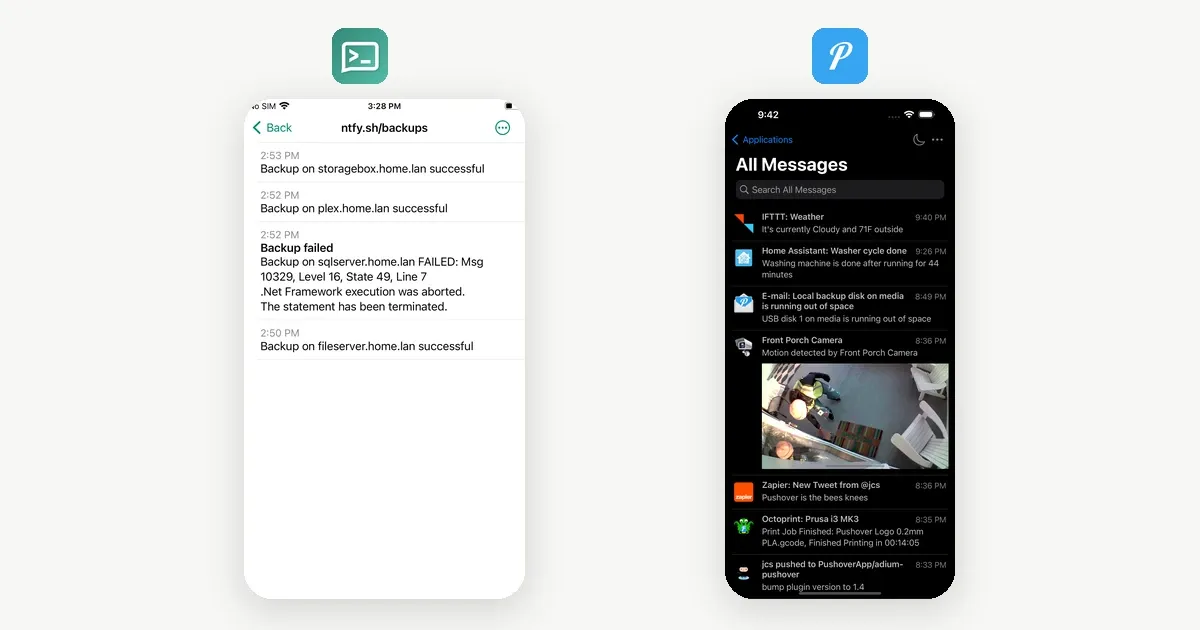
For alerts from an AI coding agent, pick ntfy if you want free, open source and the option to self-host. Pick Pushover if you want a one-time price, a mature app and emergency alerts that repeat until you acknowledge them. Both send messages one way. If the agent needs your answer back, you need a reply path on top, or a tool built to ask and wait.
All facts below were checked on 2026-11-18 on each project's own site, docs and App Store listing. We make Notifex, an app for the ask-and-wait case, and we cover it near the end. For plain alerts, ntfy and Pushover are the simpler tools.
What is the difference between ntfy and Pushover?
ntfy is an open-source HTTP pub-sub service. You publish to a topic with a plain HTTP request, and every phone subscribed to that topic gets the message. You can use the public ntfy.sh server or run your own.
Pushover is a hosted notification service. You register an application, get an API token, and send messages to your user key. Hundreds of tools and scripts already know how to post to it.
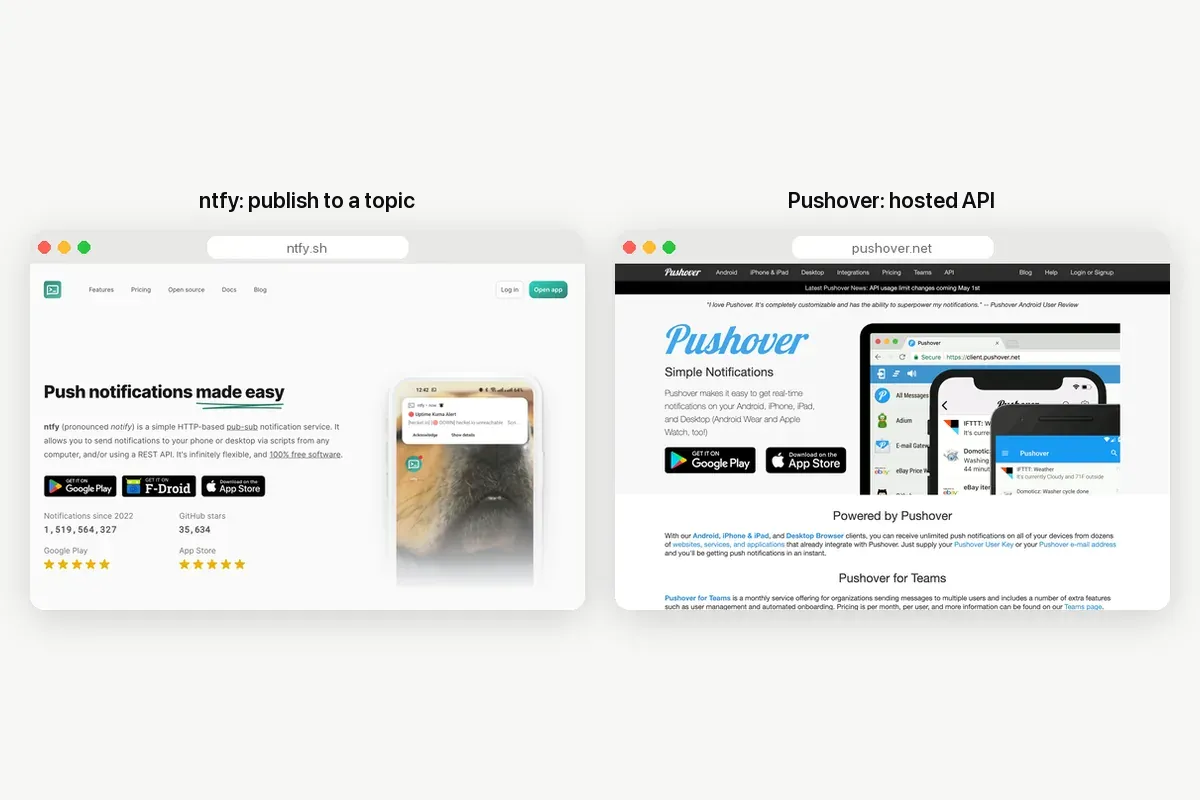
| ntfy | Pushover | |
|---|---|---|
| Model | Open-source HTTP pub-sub; public server or self-hosted | Hosted service with an HTTP API |
| Price | Free without sign-up; paid plans from $5 a month; self-hosting is free | $4.99 one-time per platform after a 30-day trial; no subscription for individuals |
| Volume | Supporter plan: 2,500 messages a day | 10,000 messages a month per account, shared by all your apps since 2026-05-01; teams 25,000 |
| Send from a script | curl -d "message" ntfy.sh/your-topic | POST to api.pushover.net with an app token and a user key |
| Apps | Android, iOS and web | iPhone and iPad, Android, desktop |
| Ways to react | Action buttons can open a link or send an HTTP request | Emergency priority repeats until acknowledged, with a receipt or callback |
| US App Store rating | 4.7 from 506 ratings | 4.8 from 4,042 ratings |
How do you send an agent notification with ntfy?
The ntfy publishing docs show the whole API in one line: send the message as the request body to your topic URL.
- Install the ntfy app and subscribe to a topic name that is hard to guess. On the public server, the topic name works like a password.
- Test from a terminal with the command below.
- Put the same command in your agent's notification hook.
curl -d "Claude Code is waiting for you" ntfy.sh/your-topic
In Claude Code, that command goes in a Notification hook, as described in the Claude Code hooks guide. In Codex, the notify setting runs a program on agent-turn-complete, and that program can make the same request. The full Claude Code setup is in Claude Code notification when done. For Codex and Cursor, see Codex notifications explained and Cursor stop hook notifications.
How do you send an agent notification with Pushover?
The Pushover API takes an HTTPS POST to its messages endpoint with three required fields: your app token, your user key and the message.
- Create an account, install the app, and note your user key.
- Register an application for your agent alerts to get an API token.
- Send a test with the command below, then move it into your hook.
curl -s --form-string "token=APP_TOKEN" --form-string "user=USER_KEY" \ --form-string "message=Claude Code is waiting for you" https://api.pushover.net/1/messages.json
Pushover also takes an image attachment and a priority. Priority 2 is the emergency level: the alert repeats until you acknowledge it.
What do reviewers report about ntfy on iOS?
Between 2026-03-02 and 2026-11-13, seven one- and two-star reviews on the ntfy App Store page report notifications that arrive silently or not at all on iPhone. Three reviews between 2025-12-19 and 2026-04-12 ask for images in the iOS app. These are reviewer reports, not test results.
One cause is documented. The ntfy server docs say iOS restricts background work, so a self-hosted server needs upstream-base-url set to forward a poll request through ntfy.sh for instant iOS notifications. If you self-host and use an iPhone, set that option first. Android does not need it.
What changed with Pushover's limits in 2026?
From 2026-05-01, Pushover counts its free monthly quota per account instead of per application, as its April 2026 announcement explains. Every app on your account now shares one pool of 10,000 messages a month. Teams share 25,000.
Pushover's own summary is that the change will not affect you unless you send many thousands of notifications a month. Agent alerts rarely reach that. A noisy hook on every finished reply across several machines could, so match the hook to what you need to hear.
Can ntfy or Pushover send your answer back to the agent?
Not by themselves. Both are built to deliver a message to you. Getting a reply back into a running agent takes extra work.
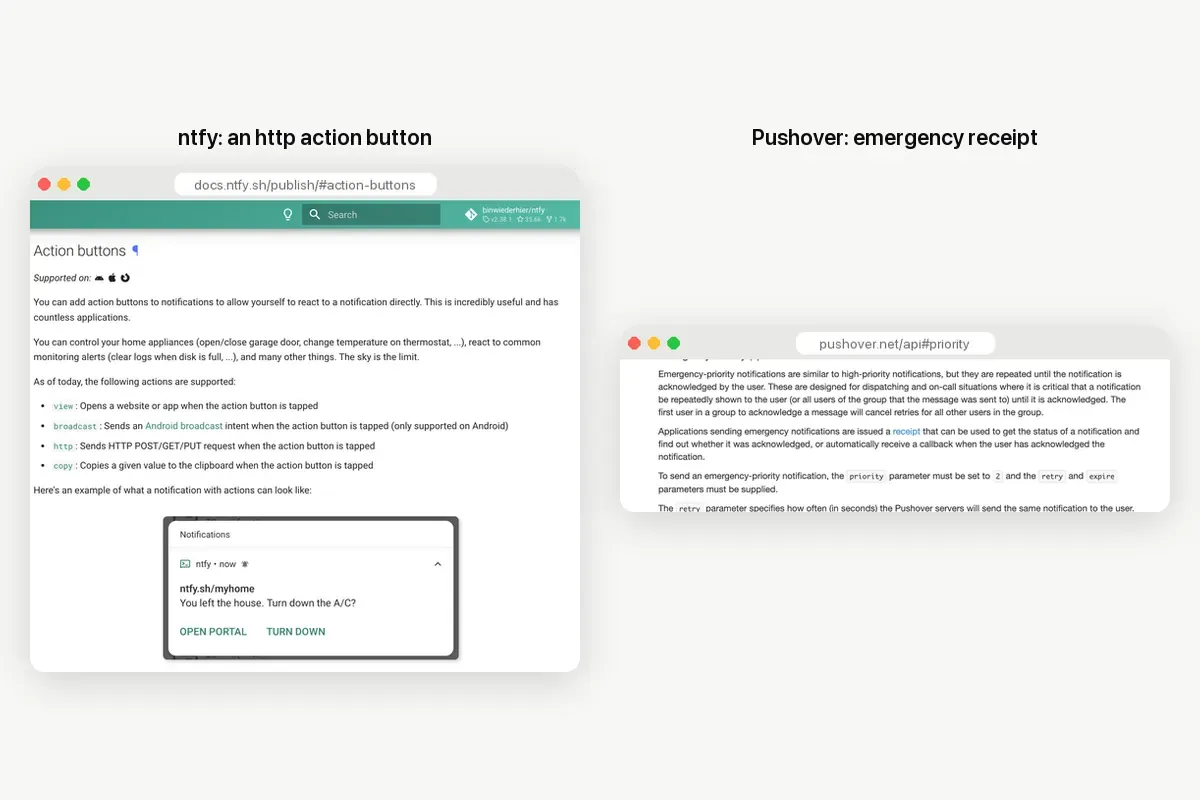
- ntfy: an http action button sends an HTTP request when you tap it. To reach the agent, you run an endpoint that receives the tap, and you teach the agent to wait for that endpoint.
- Pushover: an emergency alert returns a receipt, and Pushover can call your URL when you acknowledge it. An acknowledgement means "I saw it". It does not carry a choice between options.
For many people that is fine. A ping that says "come back, Claude is waiting" is all they need.
When do you need the answer back, not only the alert?
You need it when the agent should not guess and you will not be at the keyboard. Deploys, migrations, deletes and "which approach?" questions fall here. An alert gets you to look, but the agent still waits for you to walk back.
Notifex covers that case. The agent calls ask_question over MCP and blocks. Notifex on iPhone and Notifex on Android show the question with its options. You tap one, and the answer returns to the agent as the tool result. The agent can also attach a screenshot or a PDF, so you see what it means before you answer.
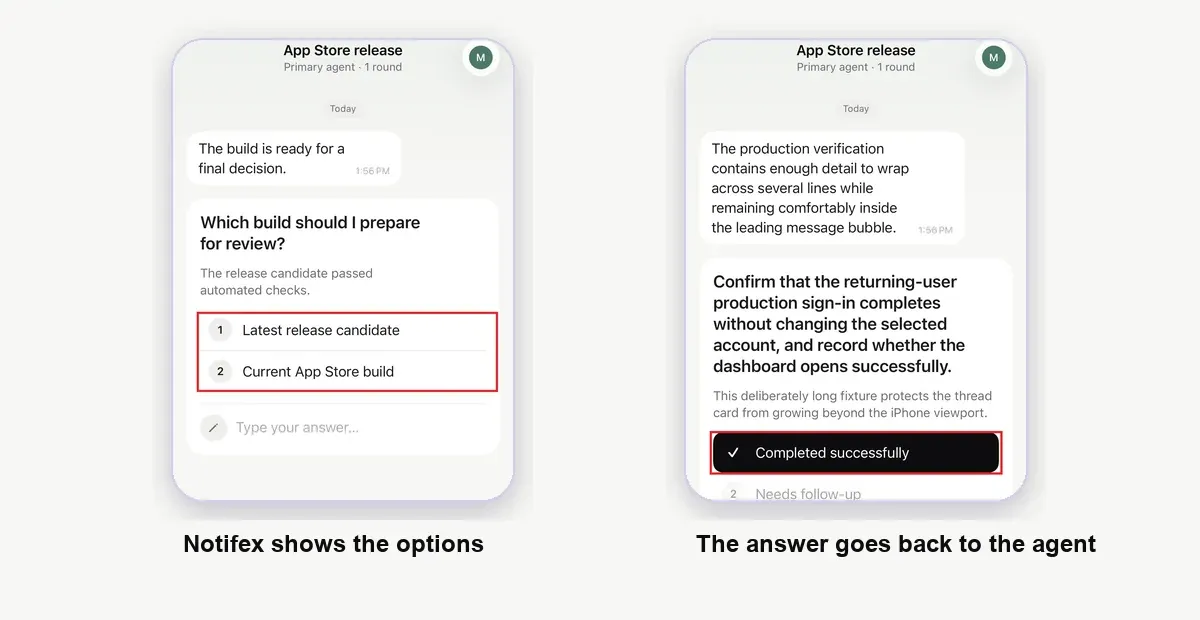
Setup is one MCP entry. Claude Code users can follow the Notifex setup steps for Claude Code; other clients are on the setup page for other clients. Notifex is free on the App Store and Google Play.
Which should you pick for your agents?
Where ntfy is the better choice
- You want open source and full control of the server and data.
- You want one
curlline from any script, cron job or CI step. - You also send alerts from home servers and monitoring, beyond agents.
Where Pushover is the better choice
- You prefer a one-time price over a subscription.
- You want emergency alerts that keep repeating until you acknowledge them.
- Many of your other tools already post to Pushover.
Where Notifex is the better choice
- The agent needs your decision, not only your attention.
- You want structured answers: single-select, multi-select or free text, up to 10 questions per push.
- A team should answer, with the first answer winning.
You can also run two side by side: ntfy or Pushover for "done" alerts, and Notifex for questions. For more ways to keep a person in charge of an agent, see alternatives for keeping a human in the loop.
Quick answers
Both work from a Claude Code Notification hook. ntfy is free and self-hostable. Pushover costs $4.99 once per platform after a 30-day trial and has emergency alerts.
If you self-host, the ntfy docs say you must set upstream-base-url so ntfy.sh can forward a poll request for instant iOS notifications. Also check the app's notification settings.
10,000 a month for free per account, shared by all your applications since 2026-05-01. Teams can send 25,000. Pushover sells higher limits.
Use a tool that sends the question and returns your answer to the agent. Notifex does this over MCP with ask_question, on iPhone and Android.
Give your agent someone to ask
Free on the App Store and Google Play. Then add one MCP entry and let your agent ask.